
From -1 to 10: The Startup Growth Stages Every Founder Must Prove
A practical framework for founders and investors in Sri Lanka and beyond.
Quick answer
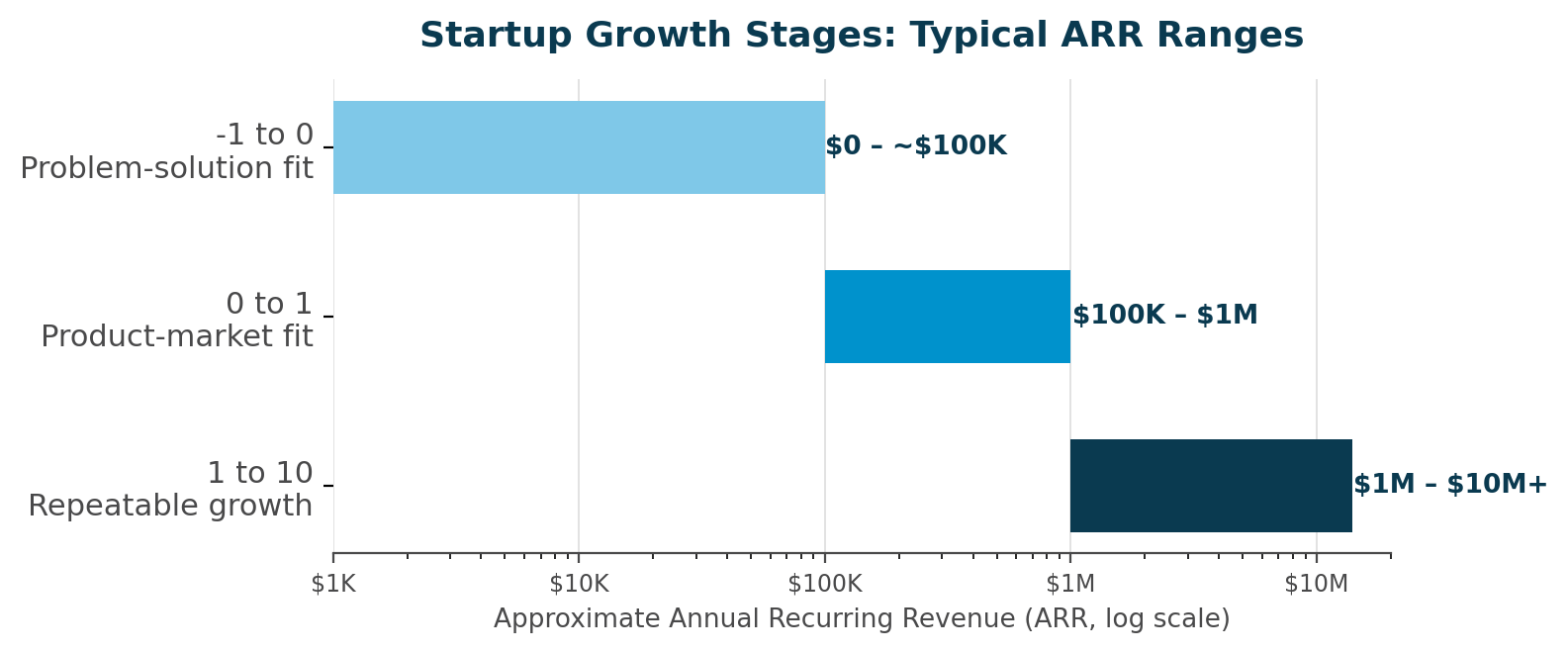
Startups don’t move from 0 to 1; they move from -1 to 10. At -1 to 0, founders prove the problem is real. At 0 to 1, they prove customers will keep paying. At 1 to 10, they prove growth is repeatable without heroics. Revenue benchmarks (roughly $0–$100K, $100K–$1M, and $1M–$10M+ ARR) are reference points, not rules. The real test at every stage is evidence, not size.
Most people think startups go from 0 to 1. They don’t; they go from -1 to 0 first.
Before a founder builds a product, finds customers or raises capital, there’s a more basic question: is this a problem worth spending the next 5 to 10 years solving? We call this problem-founder fit. A founder can discover a problem because they’ve lived it, spotted a market gap, or simply believe there’s money to be made; all three can start a company. But building a company is different from spotting an opportunity, and it can take 24 to 48 months before a founder sees meaningful financial return. If the initial motivation isn’t strong enough to survive that gap, the startup may never last long enough to find out if the opportunity was real.
Based on a decade of building, funding, scaling and exiting Sri Lankan startups, here’s how we think about the journey from -1 to 10, and what it means for founders raising capital in Sri Lanka.
The three startup growth stages
| Stage | What you’re proving | Typical ARR | Core question |
|---|---|---|---|
| -1 to 0 | Problem-solution fit | $0 to very little | Will people pay? |
| 0 to 1 | Product-market fit | ~$100K to $1M ARR | Will they keep paying? |
| 1 to 10 | Repeatable growth | ~$1M to $10M+ ARR | Can we make more people pay, repeatedly and efficiently? |
These numbers are reference points, not rules. A B2B enterprise company with ten customers looks very different from a consumer app with 100,000 users. Think of the stages as levels of evidence, not labels stuck on a company.
-1 to 0: Prove the problem is worth solving
There may be no company yet, and sometimes no product either. The founder is defining the problem, talking to customers, testing prototypes and assumptions. The problem is still being shaped; founders do everything themselves, revenue is near zero, and the central question is problem-solution fit.
Revenue is almost irrelevant here. A founder can have $0 in revenue and still be making excellent progress if the evidence looks like:
- 10 customers willing to pay
- $50K in signed contracts
- 5 enterprise pilots
- 40% of users returning monthly
- Customers switching from an existing solution
The goal isn’t revenue: it’s evidence. A founder at this stage should spend more time with customers than with investors. The right question isn’t “how much can I raise?” It’s “what evidence can I produce that this problem is real?”
0 to 1: Prove the product works in the real world
A real product exists, and customers are using it. Now the question is whether the business works in the real world, not just in a pilot. Founders are still hands-on, the product is changing fast based on feedback, revenue is small but growing, and acquisition is manual and unpolished. The central question is product-market fit.
A rough ARR benchmark is $100K to $1M, but the number matters less than what sits underneath it: revenue → retention → repeatability → growth. A company with $500K ARR and poor retention has weaker product-market fit evidence than one with $150K ARR and exceptional retention.
This is where fundraising confuses founders most. Raising a seed round doesn’t prove product-market fit. Neither does a high valuation or a large user count. The real question: do customers consistently get enough value to keep paying? And for investors: if we put another $1 in, can this company reliably create more than $1 of value? That’s where a scalable business begins.
1 to 10: Build the machine
At this stage, customers already want the product. The job now is building a machine that produces customers and revenue repeatedly, without founders doing it all personally. Signs include stronger product-market fit evidence, growing revenue, a repeatable acquisition motion, processes and systems, a growing team, and metrics that matter. ARR is typically $1M to $10M+, again a reference point rather than a rule.
The real question is whether growth is becoming repeatable: can you hire salespeople and reproduce the founder’s results? Enter a new market and reuse the playbook? Grow the customer base 10x without the founder in every decision? This is the shift from “we can make this work” to “we can make this work repeatedly, without heroics”, and that distinction matters enormously.
Being good at 0 to 1 doesn’t make you good at 1 to 10
The skills each stage demands are different. A founder who closes the first 20 customers through personal hustle has proven I can sell this. The next stage requires proving my company can sell this, without the founder on every call. The same is true for product, hiring, customer success and international expansion. Founder involvement is often an advantage at 0 to 1; at 1 to 10, excessive founder dependence becomes a constraint.
What this means for fundraising in Sri Lanka
Startup stages and funding stages are related but not the same: a company doesn’t become a “seed-stage” business simply because it raised a seed round. Capital should reflect what the company needs to prove next: validating the problem at -1 to 0, finding product-market fit and building the team at 0 to 1, and accelerating an already-working growth engine at 1 to 10. Before raising, a founder should be able to answer: what will this capital let us prove that we can’t prove today?
For Sri Lankan founders, geography adds a layer. A company can build in Sri Lanka while selling anywhere, so $100K ARR from 500 low-value local customers is a very different business from $100K ARR from 10 enterprise customers in the US or UK, even though the number is identical.
The Sri Lankan advantage: access to highly capable technical and operational talent at a comparatively lower cost. That helps early on, but cost alone doesn’t create a venture-scale company. The real opportunity is using Sri Lanka as a base for building globally competitive products, which changes the question from “how big is the Sri Lankan market?” to “how big is the market we can serve from Sri Lanka?” For software and enterprise AI, that market is often the US, UK, Singapore or Australia from day one. Build where you have an advantage. Sell where the opportunity is.
Where to focus at each stage
- -1 to 0: Focus on the problem. Talk to customers. Test assumptions. Build prototypes. Find evidence people will pay. Don’t optimise for scale before you have something worth scaling.
- 0 to 1: Focus on product-market fit. Build what customers actually want. Understand retention. Find your first repeatable acquisition channel.
- 1 to 10: Focus on repeatability. Build systems. Hire functional leaders. Create repeatable sales and marketing. Expand markets. Measure unit economics. Use capital to accelerate what’s already working.
Frequently asked questions
What is problem-founder fit?
It’s the depth of a founder’s personal reason for solving a specific problem, separate from whether the market is large or the idea sounds profitable. It matters because it can take 24 to 48 months to see meaningful returns, and weak motivation rarely survives that long.
Are startup stages the same as funding stages, like pre-seed, seed and Series A?
No. Funding stages describe how a round is labelled; startup stages describe what’s actually been proven. A company can raise a seed round without having product-market fit, and stall at 0 to 1 regardless of the label on its cap table.
How much ARR do I need to raise a seed round in Sri Lanka?
There’s no fixed number. The benchmarks in this piece ($0–$100K at -1 to 0, $100K–$1M at 0 to 1, $1M–$10M+ at 1 to 10) are reference points. What matters more is what the revenue proves: retention, repeatability, and whether it came from customers who resemble your real target market.
The three questions, restated
- -1 to 0: Will people pay?
- 0 to 1: Will they keep paying?
- 1 to 10: Can we make more people pay, repeatedly and efficiently?
Each step needs a different kind of founder, a different kind of evidence, and eventually a different kind of capital. For founders, knowing which stage you’re actually in can save months of wasted fundraising. For investors, it separates a promising idea from a promising business.
At nVentures, that’s one of the questions we keep coming back to when evaluating early-stage startups from Sri Lanka and beyond, because startups don’t become investable because they have a great story. They become investable as the evidence compounds.
If you’re building at any of these stages, or want to learn more about Fund II, reach out. We’d welcome the conversation.
nVentures backs pre-seed and seed-stage B2B fintech and enterprise AI founders, with a focus on Sri Lankan founders building for global markets.
Apply for funding