
How to Prepare for a VC Investment Committee: A Founder’s Playbook
A look at how nVentures’ investment committee, or IC, works: what we look for, how the 60-minute session runs, the questions we ask, and what separates a good pitch from a convincing one.
Quick answer
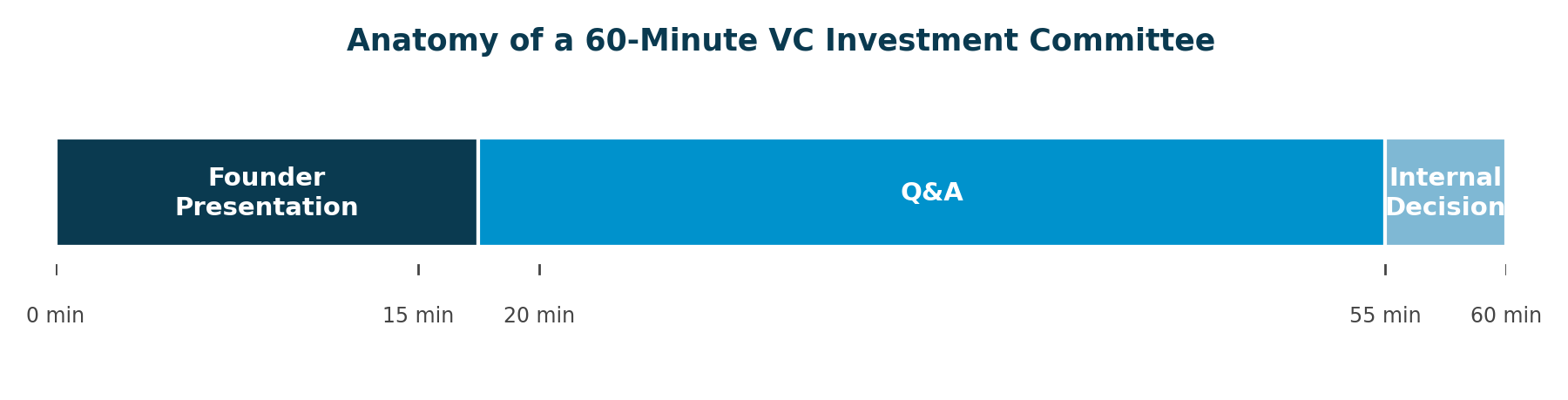
A VC investment committee, or IC, is the group within a fund responsible for evaluating an opportunity and approving an investment decision. At nVentures, our IC runs for 60 minutes across three phases: a founder presentation, an open Q&A, and an internal discussion. We assess every opportunity against the same core categories, though how much weight each carries depends on the company’s stage. For founders, the 40 minutes of Q&A often matter more than the slides that come before them.
For most founders, presenting to a VC investment committee, or IC, is a new experience. You’re no longer convincing one investor that your company is interesting. You’re giving a group of investors enough evidence to collectively decide whether to put their firm’s capital behind you. The strongest IC sessions are conversations, not rehearsed performances.
We’ve been on both sides of this table. We’ve raised capital, built companies, sat through investor meetings, and now spend our time deciding which founders to back. That gives us a different view of what actually matters in the room.
What Is a VC Investment Committee?
An investment committee is the group within a venture fund responsible for evaluating opportunities and approving investment decisions. The process varies by fund: some ICs approve the investment outright; others decide whether it moves into deeper diligence.
At nVentures, our IC runs for 60 minutes across three phases. Your presentation sets the context; the conversation that follows is where we build conviction on whether to move forward.
What Does nVentures’ IC Actually Evaluate?
Every opportunity that reaches our IC is assessed against the same core categories. What matters most within each one depends on the company’s stage, business model, and what we’re trying to understand about the opportunity.
You don’t need a perfect answer in every category. You do need to know your strengths and weaknesses, and be able to explain what you’re doing to close the gaps.
| Category | What investors are really asking |
|---|---|
| Team | Can this team execute, and do they know their own gaps? |
| Market & opportunity | Is the problem real, urgent, and large enough? |
| Competition | Who else is solving this, and why does this company win? |
| Product & defensibility | What makes this hard to replicate? |
| Scalability | Do unit economics hold as the company grows? |
| Traction | Is demand genuine, organic, and repeatable? |
| Fund strategy & use of funds | Does this fit the fund’s stage, and is the raise sized correctly? |
| Valuation, cap table & returns | Is the entry price defensible and the cap table clean? |
| Exit potential | Is there a credible path to a meaningful outcome? |
In practice, we’ve backed teams where traction or defensibility was still developing. A strong team gives us confidence those gaps can close, because the hardest thing to change after an investment is the people making the decisions.
What Actually Builds Conviction at an IC?
There’s no formula for a yes, but we see the same patterns repeatedly:
- Evidence beats adjectives. Show us what customers are doing, not how excited they are.
- Specificity beats ambition. A precise claim beats a big vision with no evidence.
- Self-awareness matters. Naming what isn’t working beats pretending it is.
- Founder insight matters. Tell us what you’ve learned that no market report would show.
- Capital should have a job. Tell us what this round lets you achieve.
- Risk doesn’t disappear because you don’t mention it. Name it before we find it.
How Should You Structure Your Presentation?
A good IC deck is usually 10 to 15 slides. It’s a framework for the conversation, not a document meant to answer every question we might ever ask.
Every extra slide takes time from the Q&A. Your goal isn’t to pre-empt every question; it’s to give us enough context for a useful conversation.
| Slide | What to cover | The question it answers |
|---|---|---|
| 1. Big picture | What you’re building, for whom, and why now | Can I explain this company in two minutes? |
| 2. Customer & problem | Who has the problem, how they solve it today | Is this problem real and urgent? |
| 3. Product | The core workflow or insight that creates value | Why do customers choose this over alternatives? |
| 4. Traction | The 2–3 metrics that prove your thesis | Is the market actually responding? |
| 5. Market & competition | Bottom-up sizing and real alternatives customers use today | How big is this, and why do you win? |
| 6. Team | Relevant experience and honest gaps | Can this team execute? |
| 7. Investment case | Amount, terms, use of funds, milestones | What does our capital allow you to achieve? |
An IC isn’t deciding whether your company deserves funding. It’s deciding whether the opportunity can generate an attractive return for the risk involved. Your job is to make that case as clearly as possible.
What Convincing Answers Sound Like
| Slide | Weak | Strong |
|---|---|---|
| Purpose | “To become the market leader” | “To reach $100M in ARR” |
| Problem | “Compliance is broken” | “A bank with 200,000 customers still reviews 30% of alerts manually” |
| Competition | “We don’t have any competitors” | “Banks rely on spreadsheets and manual review today. We replace the costliest part of that.” |
| Traction | “We’re working with leading banks” | “Three banks are live, two are paying, and one has expanded from one branch to nationwide.” |
| Market | “The global compliance market is worth $40 billion” | “Our first 100 target customers represent roughly $2M in annual contract value.” |
The pattern is always the same: specific, falsifiable claims beat confident-sounding abstractions.
What Questions Do Investors Ask in Q&A?
| Category | Sample questions |
|---|---|
| Team | What’s the biggest mistake you’ve made? What capability is missing? |
| Market | How did you size the market? Why hasn’t an incumbent solved this? |
| Competition | Who are your real competitors, including manual workarounds? |
| Product | What’s difficult to copy? What’s your actual moat beyond price? |
| Traction | How many of your logos are paying versus piloting? What did the ones who said no tell you? |
| Investment | Why this amount? What milestone does it fund? |
Two of these come up more than founders expect. First, “what’s your moat beyond price?” A low-cost advantage is common; a defensible one is rare. Second, investors will often call your named customers directly, not just read your logos slide.
We don’t expect a full moat at pre-seed, just a sense of what could become defensible.
You don’t lose points for saying you don’t know. You lose credibility when your answer sounds more certain than the evidence allows.
What Mistakes Do First-Time Founders Make at an IC?
| Mistake | Why it hurts | The fix |
|---|---|---|
| Overstating the market | A huge top-down TAM doesn’t prove you can capture it | Show bottom-up sizing and the customers you can actually reach |
| No clear ask | Signals the raise hasn’t been planned | Know your amount, terms, use of funds, and milestones cold |
| Claiming “no competitors” | Creates more questions than it answers | Name the real alternatives, including manual processes |
| Treating logos as done deals | A pipeline of “interested” customers isn’t traction | Be precise about who’s paying, piloting, or just talking |
| Becoming defensive | Makes it harder to distinguish conviction from defensiveness | Acknowledge the concern, explain what you’ve learned, and what you’re doing about it |
| Confusing interest with demand | Meetings, LOIs, and pilots signal interest, not paying customers | Separate conversations, pilots, signed contracts, paying customers, and expansion revenue |
Case Study: What Our IC Saw, and What’s Happened Since
To make this concrete without exposing deal terms, here’s a real example. Dossiers, an AI compliance startup, went through this exact process. We’re not disclosing the terms of that investment, but the gap between what our IC flagged at the time and what’s since become public is worth walking through.
| Factor | What IC saw | What’s public since |
|---|---|---|
| Team | Two technical co-founders with a shared founding history, but still just the two of them | The team has since grown beyond the founding pair |
| Product roadmap | Built for customer screening, with an ambition to become a full compliance operating system | Now shipping a unified fraud-prevention and AML platform, delivered alongside a compliance consulting partner |
| Differentiation | Flagged as a real risk: not much of a moat beyond being cheaper than incumbents | Has since leaned into a data-sourcing edge drawn from an investigative-journalism network, which is harder to copy than price |
| Market credibility | Solving a real regulatory problem, but an unproven voice in the space | Founders have since featured in national AML policy events and trade press |
None of this proves the investment will return capital. Early momentum isn’t an exit, and the risks we flagged didn’t vanish overnight. But it’s a real illustration of the pattern above: a strong founding team doesn’t eliminate risk; it changes our confidence that the team can navigate it. What we saw was a capable team working through the gaps we identified. Over time, some of those gaps became strengths.
Before Your IC, Get Your Data Room Ready
You don’t need a perfect data room to present, but having one ready signals readiness and shortens everything that follows if we move forward. What matters most is that someone unfamiliar with the business can navigate it without needing you to explain where everything is. At minimum, have these categories organised:
| Category | What belongs there |
|---|---|
| Corporate documents | Incorporation certs, cap table, shareholder agreements |
| People | Founder and exec profiles, board and advisory bios |
| Product & technology | Roadmap, architecture, IP, live or recorded demo |
| Commercial | GTM strategy, pricing, revenue streams |
| Market & competitive landscape | Market analysis, competitor positioning |
| Financials | Audited statements if available, projections, burn and unit economics |
Don’t manufacture perfection. Missing information is easier to deal with than inconsistent information; if something isn’t ready, say so, and explain why.
Frequently Asked Questions
What happens after a VC investment committee?
If the committee decides to proceed, the company typically moves into deeper due diligence ahead of a term sheet. If the committee passes, many funds share high-level feedback, though how much detail is shared varies by fund.
How is an IC different from a first investor meeting?
An IC is evaluating whether an entire firm should commit capital, not whether one individual investor is intrigued. Expect more rigorous, multi-angle questioning than in a first meeting.
Does a strong team make up for weak traction?
It can, up to a point. We’ve seen teams carry deals where traction was still early, but it doesn’t substitute for a credible plan to build that traction.
If you’re a pre-seed or seed enterprise AI founder preparing for an IC, we hope this gives you a better sense of what happens on the other side of the table. And if you’re building for mature markets from Sri Lanka or elsewhere in South Asia, we’d like to hear what you’re building.
nVentures backs pre-seed and seed-stage B2B fintech and enterprise AI founders, with a focus on Sri Lankan founders building for global markets.
Apply for funding